
Published on: 27 November 2026
A sagging face is the gradual downward shift and loosening of facial tissue that comes with age, affecting the jawline, cheeks, brows, and neck. It is rarely caused by loose skin alone, as several layers beneath the surface change over time and each contributes in a distinct way. Understanding which layers are involved explains why no single treatment addresses every sign of ageing, and why a thorough clinical assessment is essential prior to undergoing any aesthetic procedure.
Key Takeaways
- Facial sagging involves several tissue layers simultaneously: skin, subcutaneous fat, the Superficial Musculoaponeurotic System (SMAS), retaining ligaments, and underlying bone.
- Collagen and elastin decline steadily from early adulthood, reducing the skin’s structural resiliency.
- Facial fat sits in separate compartments that lose volume and shift downwards at different rates.
- Gradual bone absorption around the orbit, midface, and jawline reduces support for overlying soft tissues.
- Management strategies depend on identifying the specific anatomical layer responsible for structural changes.
What Causes the Face to Sag?
Facial laxity occurs as multiple supporting anatomical layers change concurrently: the dermis loses structural proteins, fat pads deflate and descend, fibrous ligaments loosen, and the underlying skeletal framework gradually recedes. External factors, most notably solar ultraviolet radiation, accelerate these internal processes.
Because each layer ages on its own timeline, individuals of the same age can display vastly different structural changes.
Dermal and Epidermal Layers (Skin)
From early adulthood, dermal collagen synthesis decreases by approximately 1% annually with women losing about 2% of collagen per each menopausal year. Simultaneously, elastin fibres undergo fragmentation, rendering the skin thinner, less firm, and slower to recoil. Skin-level ageing typically manifests as fine lines, superficial texture changes, and a mild loss of contour sharpness.
Facial Fat Compartments
Facial fat is not one continuous sheet. Anatomical studies show that facial fat is organized into distinct superficial and deep compartments separated by fibrous septa across the forehead, cheeks, nasolabial region, and jowls.
These compartments experience volume loss and repositioning at different rates. Deflation of the deep midface fat pads reduces central facial support, which can deepen the nasolabial folds and permit lower facial tissues to accumulate along the mandible as jowls.
SMAS and Retaining Ligaments
The Superficial Musculoaponeurotic System (SMAS) is an underlying fibromuscular network that acts as a structural scaffold, anchored to the facial skeleton by true and false retaining ligaments. With age, these ligaments lax and the SMAS layer loses tension, causing soft tissue previously situated over the cheekbone to descend.
While traditionally repositioned during a surgical facelift, this deep layer can also be targeted non-surgically using focused energy-based technologies, such as micro-focused ultrasound or radiofrequency.
Skeletal Resorption (Bone)
Facial bones undergo continuous remodeling throughout life. Research in skeletal ageing indicates that the eye sockets widen, midfacial skeletal support recedes, and the jawline loses vertical and horizontal definition over time.
Because bone forms the foundational structure for all overlying tissue, even subtle bone loss reduces overall support across the face. This explains why jawline laxity can develop even in individuals with good skin quality.
At What Age Does Facial Laxity Begin?
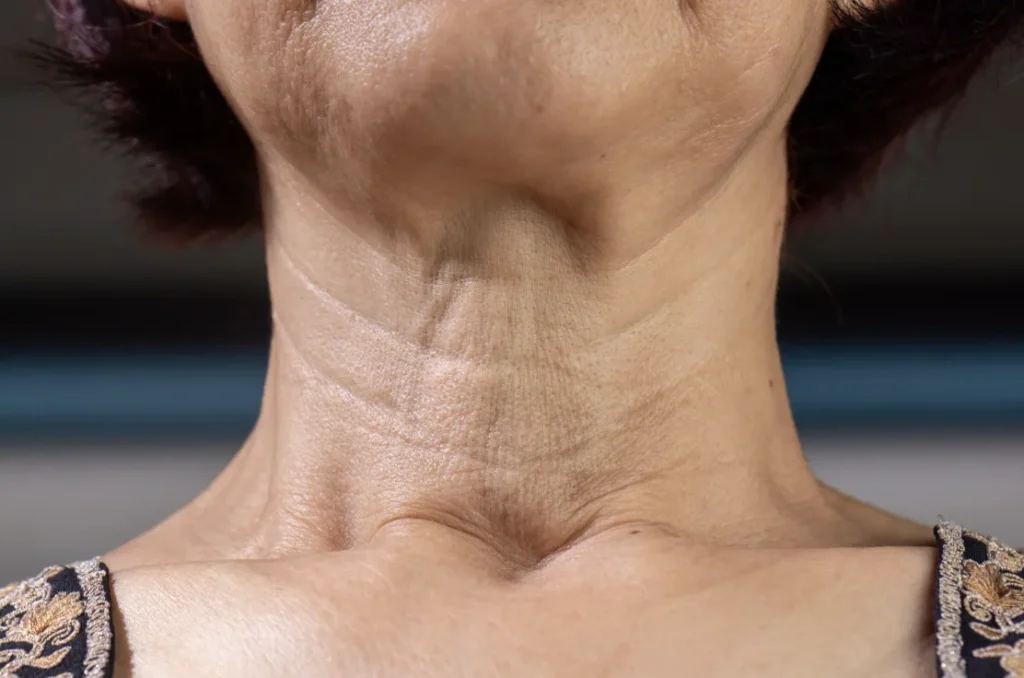
Initial signs of tissue laxity often present in the mid-to-late thirties, with more pronounced changes along the jawline and midface emerging during the forties and fifties. The precise timeline varies significantly based on genetic predisposition, facial bone structure, body weight fluctuations, and cumulative sun exposure.
By the time noticeable jowling or volume loss occurs, structural changes within the deeper anatomical layers have usually been progressing for several years.
How UV Exposure in Singapore Accelerates Ageing
Singapore experiences high to extreme UV index levels throughout the year. Ultraviolet radiation, specifically UVA rays, penetrates deep into the dermal layer, generating reactive oxygen species that accelerate the degradation of collagen and elastin fibers (photoageing).
Cumulative daily exposure from routine outdoor activities or commutes contributes significantly to premature skin laxity. Daily application of broad-spectrum sunscreen helps mitigate dermal degradation, though it cannot prevent underlying fat or bone resorption.
Non-Surgical Approaches to Addressing Facial Laxity
Mild to moderate facial laxity may be managed non-surgically when modalities are matched appropriately to the affected anatomical layer. Advanced sagging involving significant skin redundancy or severe tissue descent may warrant surgical consultation.
Matching the Cause to a Treatment Category
Mild to moderate facial laxity may be managed non-surgically when modalities are matched appropriately to the affected anatomical layer. During a facial assessment, each layer is examined before facial sculpting treatments or energy-based options are recommended.
| Layer affected | What it looks like | Treatment category to consider |
|---|---|---|
|
Skin |
Thinning, fine lines, crepey texture |
Collagen-stimulating therapies, ablative lasers |
|
Fat compartments |
Midface descent, loss of jawline definition |
Volume restoration using injectable dermal fillers or biostimulators |
|
SMAS and ligaments |
Descent of the cheek and jawline |
Micro-focused ultrasound or other deep tissue heating modalities such as microneedle radiofrequency |
|
Bone |
Flattened cheek contours, receding chin/jaw |
Structural support with fillers in key areas |
The objective of non-surgically addressing facial laxity is to restore balance and underlying structural support rather than overfilling or artificially stretching the tissue.

Why Choose Dr Shane for Treatment in Singapore?
If you are ready to move past the uncertainty of retail wellness trends and explore evidence-based clinical treatments tailored to your face, we welcome you to contact our team.
At Dr Shane’s clinic, we believe remarkable results begin with three fundamentals: medical precision, honest advice, and customised care.
While many clinics focus on selling treatments, we prioritise:
- In-depth 1-1 skin health consultations (at least 30 mins)
- HSA/FDA-compliant protocols using approved devices with documented safety profiles
- Personalised energy settings adjusted for your unique skin thickness and concerns
What makes our approach different?
✔ Doctor-Led Consultations
Every treatment plan begins with a medical evaluation of your skin’s needs – not a sales conversation.
✔ Safety-First Philosophy
We use only HSA-approved devices and disclose all potential risks transparently.
✔ No Pressure, Just Professional Advice
You’ll leave your consultation either:
- Confident this treatment is right for you, or
- Aware of better alternatives for your goals
✔ Natural-Looking Results
Our treatment plans prioritise gradual, authentic improvement over dramatic but short-lived changes.
✔ Continued Aftercare
Post-treatment guidance to help maintain and optimise your results
The First Step is Always a Conversation
Many patients discover during consultation that their skin concerns actually require:
→ A different treatment approach
→ Combination therapies
→ Or simply more time before considering procedures
Book a skin health assessment to get professional insights before deciding on any treatment.
Let us help you find what’s right for your skin—not just what’s trending.