
Published on: 27 November 2026
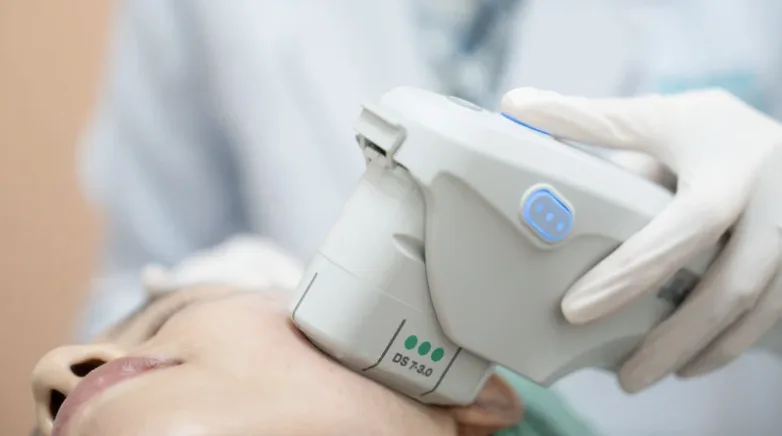
Ultherapy uses micro-focused ultrasound to heat precise structural layers beneath the surface, triggering your body’s natural collagen and elastin production. Because these structural changes rely on biological tissue remodeling, results develop gradually over several months. How quickly you notice visible improvements depends on treatment planning, delivery technique, and individual biological factors.
Key Takeaways
- Ultherapy triggers neocollagenesis, a natural tissue-rebuilding process unfolding over two to six months.
- A temporary firming feeling immediately after treatment is caused by heat-induced fibre contraction and mild swelling, not the final result.
- Treatment depth, transducer choice and line placement influence the strength of the collagen response as much as the device itself.
- Patient age, baseline collagen reserve, degree of skin laxity, and UV exposure influence how quickly change becomes visible.
- Clinical progress is best assessed at three to six months via standardised photography.
How Soon Do You See Results After Ultherapy?
Most patients observe early improvements in skin firmness within four to eight weeks, with more visible lifting developing between three and six months after a single session. This timeline is reflected in the clinical evidence. In a rater-blinded study of ultrasound tightening published in the Journal of the American Academy of Dermatology, clinical outcomes were evaluated at 90 days post-treatment, showing measurable tissue tightening on standardised photographs.
What Happens Beneath the Skin During Treatment?
Ultherapy does not mechanically pull or lift tissue. Instead, micro-focused ultrasound energy passes through the skin surface without damaging it, delivering precise thermal energy points at target depths between 60°C and 70°C.
- Immediate Response (Days 1 to 14): Existing collagen fibres contract in response to heat.
- Neocollagenesis (Weeks 2 to 12): Thermal injury signals dermal fibroblasts to synthesise new collagen and elastin matrix.
- Maturation (Months 3 to 6+): Newly formed collagen fibres align, cross-link, and strengthen, resulting in progressive skin firming.
Treatment Technique and Depth Selection
Two people can be treated with the same device and still see different results, because the device is only as effective as the plan behind it. This is why the approach to Ultherapy treatment in Singapore begins with mapping each face before any energy is delivered.
Targeted Layers (1.5mm, 3.0mm, and 4.5mm)
Ultherapy uses different transducers to reach different depths. The 4.5mm transducer targets the Superficial Musculoaponeurotic System (SMAS), while the 3.0mm and 1.5mm transducers reach the deeper and more superficial dermis. Treating the lifting layer and the skin-quality layers together, where appropriate, tends to give a more balanced result than treating one depth alone.
Vectoring and Real-Time Ultrasound Imaging
Where lines are placed, and in which direction, affects how tissue is lifted. Lines applied along the natural vectors of facial support can direct tightening upwards and outwards rather than simply shrinking the treated area.
Real-time ultrasound imaging allows the practitioner to view target tissue layers prior to delivering energy, ensuring treatment reaches the designated anatomical depth while avoiding bone or blood vessels. A long-term study of a customised vectoring approach in the Journal of Clinical and Aesthetic Dermatology reported sustained improvement in lax facial and neck skin, supporting the view that planning, not just the device, shapes outcomes.
Factors Influencing the Speed and Visibility of Results
If noticeable changes are not visible in the early weeks, collagen remodelling is likely still in progress. Differences in response rates generally depend on individual physiological factors:
- Collagen Reserve and Age: Individuals with mild to moderate skin laxity retain higher fibroblast activity and respond more predictably. Severely aged skin or advanced laxity may demonstrate a slower response due to depleted cellular reserves.
- Laxity vs. Volume Loss: Ultrasound lifting addresses tissue laxity, not structural volume loss. When mid-face hollowing or temple depression contributes to facial aging, volume restoration options may be considered alongside ultrasound lifting.
- Environmental & Lifestyle Factors: High UV exposure breaks down structural collagen. Diligent daily broad-spectrum sun protection helps protect newly formed collagen. Smoking, insufficient sleep, and systemic stress can also slow tissue repair.
Evaluating Progress: When to Reassess
Gradual change is hard to see in the mirror day to day, so standardised clinical photographs taken before treatment and at follow-up give a far more reliable picture. A review from around three months looks at firmness, jawline definition and brow position. If change remains limited at six months, the conversation turns to which complementary approach might help.
Is One Session Enough?
For mild to moderate laxity, one session produces a visible improvement. Patients with higher baseline laxity may benefit from an additional session, typically considered only after the first has had time to mature fully.
Because new collagen continues to develop for several months, repeating treatment too early rarely speeds up results. Maintenance planning depends on age, skin quality and how the result holds, and is best tailored at your follow-up review rather than set in advance.

Why Choose Dr Shane for Treatment in Singapore?
If you are ready to move past the uncertainty of retail wellness trends and explore evidence-based clinical treatments tailored to your face, we welcome you to contact our team.
At Dr Shane’s clinic, we believe remarkable results begin with three fundamentals: medical precision, honest advice, and customised care.
While many clinics focus on selling treatments, we prioritise:
- In-depth 1-1 skin health consultations (at least 30 mins)
- HSA/FDA-compliant protocols using approved devices with documented safety profiles
- Personalised energy settings adjusted for your unique skin thickness and concerns
What makes our approach different?
✔ Doctor-Led Consultations
Every treatment plan begins with a medical evaluation of your skin’s needs – not a sales conversation.
✔ Safety-First Philosophy
We use only HSA-approved devices and disclose all potential risks transparently.
✔ No Pressure, Just Professional Advice
You’ll leave your consultation either:
- Confident this treatment is right for you, or
- Aware of better alternatives for your goals
✔ Natural-Looking Results
Our treatment plans prioritise gradual, authentic improvement over dramatic but short-lived changes.
✔ Continued Aftercare
Post-treatment guidance to help maintain and optimise your results
The First Step is Always a Conversation
Many patients discover during consultation that their skin concerns actually require:
→ A different treatment approach
→ Combination therapies
→ Or simply more time before considering procedures
Book a skin health assessment to get professional insights before deciding on any treatment.
Let us help you find what’s right for your skin—not just what’s trending.